Vitra Noguchi Freeform Ottoman
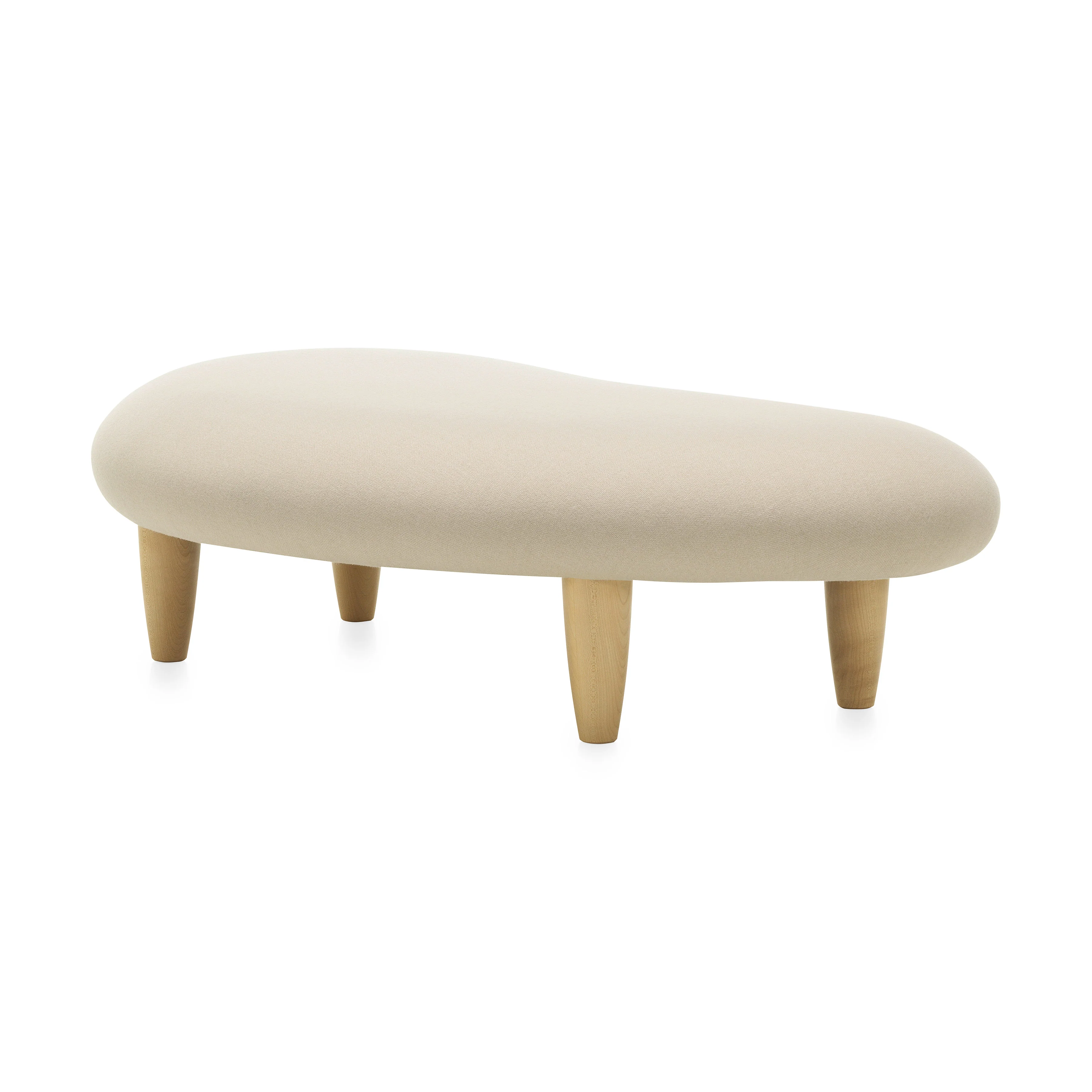
This ottoman is part of Isamu Noguchi’s 1946 project to redefine the concept of sofa seating through his sculptural sensibilities. Along with its coordinated sofa, it evokes a group of smooth river rocks rendered in a comfortably upholstered, flowing composition. The elegantly organic design has a solid beechwood frame, natural maple legs, and removable upholstery. Made in Germany by Vitra, a manufacturer of iconic modern furnishings that’s widely represented in MoMA’s collection.
At 15, Isamu Noguchi’s Art teacher declared that he'd “never be a sculptor.” Fortunately, he didn’t listen to that discouraging prediction. He went on to become an artist and designer whose work transcended stylistic silos, movements, and cultures. His propensity for overlooking labels and borders may have stemmed from his family: His Japanese father was a poet and his Scottish-American mother a writer. “I do not wish to belong to any school,” he said. “I am always learning, always discovering.” His wide-ranging work includes the gardens for the UNESCO Building in Paris and fountains for Tokyo’s Supreme Court Building. His collaboration with Herman Miller began when one of his designs was used to illustrate George Nelson’s article, “How to Make a Table.” That design became his iconic coffee table, introduced in 1947. 28 examples of his designs are included in MoMA’s collection, illustrating the breadth of his work across various media and styles.
This ottoman is part of Isamu Noguchi’s 1946 project to redefine the concept of sofa seating through his sculptural sensibilities. Along with its coordinated sofa, it evokes a group of smooth river rocks rendered in a comfortably upholstered, flowing composition. The elegantly organic design has a solid beechwood frame, natural maple legs, and removable upholstery. Made in Germany by Vitra, a manufacturer of iconic modern furnishings that’s widely represented in MoMA’s collection.
At 15, Isamu Noguchi’s Art teacher declared that he'd “never be a sculptor.” Fortunately, he didn’t listen to that discouraging prediction. He went on to become an artist and designer whose work transcended stylistic silos, movements, and cultures. His propensity for overlooking labels and borders may have stemmed from his family: His Japanese father was a poet and his Scottish-American mother a writer. “I do not wish to belong to any school,” he said. “I am always learning, always discovering.” His wide-ranging work includes the gardens for the UNESCO Building in Paris and fountains for Tokyo’s Supreme Court Building. His collaboration with Herman Miller began when one of his designs was used to illustrate George Nelson’s article, “How to Make a Table.” That design became his iconic coffee table, introduced in 1947. 28 examples of his designs are included in MoMA’s collection, illustrating the breadth of his work across various media and styles.
Original: $4,750.00
-70%$4,750.00
$1,425.00Description
This ottoman is part of Isamu Noguchi’s 1946 project to redefine the concept of sofa seating through his sculptural sensibilities. Along with its coordinated sofa, it evokes a group of smooth river rocks rendered in a comfortably upholstered, flowing composition. The elegantly organic design has a solid beechwood frame, natural maple legs, and removable upholstery. Made in Germany by Vitra, a manufacturer of iconic modern furnishings that’s widely represented in MoMA’s collection.
At 15, Isamu Noguchi’s Art teacher declared that he'd “never be a sculptor.” Fortunately, he didn’t listen to that discouraging prediction. He went on to become an artist and designer whose work transcended stylistic silos, movements, and cultures. His propensity for overlooking labels and borders may have stemmed from his family: His Japanese father was a poet and his Scottish-American mother a writer. “I do not wish to belong to any school,” he said. “I am always learning, always discovering.” His wide-ranging work includes the gardens for the UNESCO Building in Paris and fountains for Tokyo’s Supreme Court Building. His collaboration with Herman Miller began when one of his designs was used to illustrate George Nelson’s article, “How to Make a Table.” That design became his iconic coffee table, introduced in 1947. 28 examples of his designs are included in MoMA’s collection, illustrating the breadth of his work across various media and styles.